Ever noticed those three businesses that magically appear at the top of Google search results when you look for a “plumber near me” or “best coffee shop in Abbotsford?” That, my friends, is the Google Map Pack (or Local Pack), and it’s gold. Pure, unadulterated gold for local businesses like yours and mine.
If you’re running a business here in the city – whether you’re fixing leaky pipes, serving up delicious lattes, offering top-notch legal advice, or creating beautiful gardens – getting into that Map Pack isn’t just a bonus; it’s practically essential. Why? Because when people are searching for something locally, they’re usually ready to act. They need a solution now, and they’re looking for the easiest, most trustworthy option right in front of them.
And let’s be honest, in a vibrant, growing community like ours, competition is healthy! But healthy competition means you need every edge you can get. That’s exactly what dominating the Google Map Pack gives you.
So, buckle up! We’re going to walk through this step-by-step. No jargon, just clear, actionable advice that you can implement starting today. My goal is to make sure your local business isn’t just on the map, but leading the map.
Understanding the Lay of the Land: What Exactly IS the Google Map Pack?
Before we dive into how to conquer it, let’s make sure we’re all on the same page. The Google Map Pack is that prominent box that shows up at the top of Google’s search results for location-based searches. It typically displays:
- Three businesses: These are Google’s top picks.
- Their names and categories: e.g., “Abbotsford Auto Repair,” “Coffee Shop.”
- Their star ratings and number of reviews: Social proof right there!
- Their address and phone number: Instant contact info.
- A small map: Showing their exact location.
- Links: To their website, directions, and sometimes a call button.
Take a look:
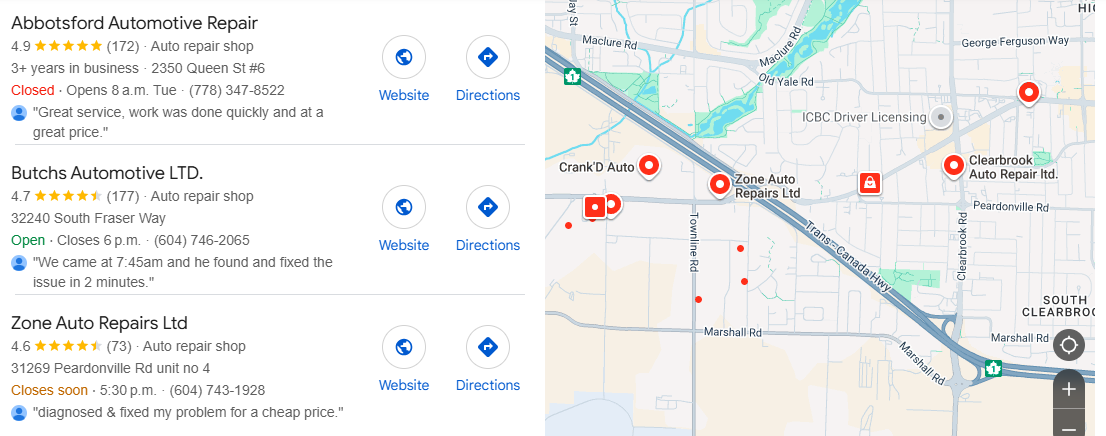
See? It’s front and center, pushing down the traditional organic search results. This means if you’re not in it, you’re missing out on a huge chunk of potential customers who are looking to buy or use a service right now.
Google uses several factors to decide who gets those coveted top three spots. We’re going to tackle each one.
Step 1: Your Google Business Profile (GBP) – The Foundation of Your Local Kingdom
This is where it all begins. Your Google Business Profile (formerly Google My Business) is your free local business listing on Google. Think of it as your primary online identity for local search. It’s absolutely CRITICAL to have this optimized if you want to rank in the Map Pack.
Action Plan for Your GBP:
- Claim and Verify Your Listing (If you haven’t already!):
- Go to business.google.com.
- Search for your business name. If it pops up, click “Manage now.” If not, click “Add your business to Google.”
- Follow the prompts to add all your accurate information.
- Google will likely send you a postcard with a verification code to your physical address. This confirms you actually exist at that location. Don’t skip this! It’s how Google trusts you.
- Fill Out EVERY Single Field – Seriously:
- Business Name: Use your exact, legal business name. Don’t stuff keywords in here. (e.g., “The Best Plumbers 24/7” might get you penalized. “Abbotsford Plumbing & Heating Ltd.” is good, if that’s your legal name.)
- Category: This is SUPER important. Choose the most specific primary category that accurately describes your main service. Then, add all relevant secondary categories. Google uses these to understand what you do.
- Address: Ensure this is exact and matches what’s on your website and other directories. P.O. boxes don’t work here; it needs to be a physical location where customers can visit or where you operate from.
- Service Areas: If you serve customers beyond your physical address (e.g., you’re a plumber covering the entire Fraser Valley), define your service areas. This is crucial for service-area businesses.
- Hours of Operation: Be precise, including special holiday hours.
- Phone Number: Your primary business phone.
- Website: Link directly to your business website.
- Description: Write a compelling, keyword-rich (but natural-sounding!) description of your business. What makes you stand out right here in the city? What services do you offer?
- Products/Services: Use this section! List out your specific services or products. This helps Google understand your offerings in detail.
- Photos: This is huge! Upload high-quality photos of your storefront, interior, team, products, and services. People love visuals. A local coffee shop might show their latte art; a dentist, their welcoming waiting room. Make it authentic. Google also prefers photos that are geotagged (often automatically done if taken with a phone at your location).
- Keep your Listing Fresh and Active:
- Google Posts: Treat your GBP like a mini-social media feed. Create “Posts” regularly – announce specials, events, new products, or even just a friendly update. These show up directly in your profile and can grab attention.
- Q&A Section: Monitor and answer questions people ask on your profile. You can also proactively add your own FAQs and answers to control the narrative.
Why is this so powerful? Google wants to provide the most relevant, accurate, and complete information to its users. A fully optimized GBP signals to Google that you are a legitimate, active, and helpful business in the community. It’s like telling Google, “Hey, I’m here, I’m open, and I’m ready for business!”
Step 2: Reviews – Your Local Reputation on Full Display
We all know reviews are important, right? But for the Google Map Pack, they’re not just important; they’re a massive ranking factor. Think about it: when you’re searching for something, aren’t you more likely to click on the business with 4.8 stars and 150 reviews versus one with 3.5 stars and 10 reviews? Of course!
Google knows this. High quantity, high quality, and recent reviews signal to Google that your business is trustworthy, reputable, and provides a good experience.
Action Plan for Reviews:
- Ask for Reviews (Don’t be shy!):
- In-person: “If you enjoyed our service today, we’d really appreciate it if you could leave us a quick Google review!”
- Via Email/Text: Send a follow-up email or text after a service or purchase with a direct link to leave a Google review. Make it easy for them! (You can generate a direct review link from your GBP dashboard.)
- On your website: Have a prominent “Leave a Review” button.
- On your receipts/invoices: Print a reminder or QR code.
- Respond to ALL Reviews – The Good, The Bad, and The Ugly:
- Positive Reviews: Thank them! Be specific if you can. “Thanks, Sarah! We’re so glad you enjoyed our new chai latte at our Abbotsford location!” This shows appreciation and reinforces your local connection.
- Negative Reviews: This is where you shine. Respond professionally, empathetically, and offer a solution or a way to take the conversation offline. “We’re truly sorry you had that experience, John. We pride ourselves on our customer service. Please call us directly at [phone number] so we can make this right.” This shows potential customers that you care and are responsive, even when things go wrong. Never get into a public argument.
- Focus on Quantity AND Quality:
- Quantity: The more reviews, the better. It shows activity and consistent positive experiences.
- Quality: High star ratings are obviously preferred. But Google also looks at the content of the reviews. Are people mentioning your services, your location, your staff? This contextual information helps Google understand your business even better. Encourage customers to be specific!
- Avoid Fake Reviews (Seriously):
- Don’t buy reviews. Don’t have your staff review your own business. Google is smart, and getting caught can lead to penalties, including losing your Map Pack visibility entirely. It’s just not worth it.
Why are reviews a Map Pack superpower? They directly influence customer trust and provide fresh, relevant content about your business. Google sees them as social proof that your business is legitimate and provides value to the community.
Step 3: Proximity – Being Where Your Customers Are (Digitally Speaking)
This one is fairly straightforward but incredibly important. Proximity refers to how close your business is to the person searching. If someone searches “pizza near me” while they’re in the heart of downtown Abbotsford, Google will prioritize pizza places closest to them.
Action Plan for Proximity (and how to optimize for it):
- Accurate Address on GBP: As mentioned in Step 1, ensure your address is perfectly accurate and consistent everywhere online.
- Service Areas (For mobile businesses): If you don’t have a physical storefront where customers visit (e.g., a mobile detailing service, a home-based consultant), make sure you properly define your service areas within your GBP. You’ll set your primary address as your home base but hide it from public display, then list the cities/regions you serve (like Abbotsford, Mission, Sumas Prairie, etc.).
- Local Keywords on Your Website: While your physical address handles direct proximity, using “Abbotsford” naturally throughout your website content signals to Google that you serve this area. (More on this in the next step!)
- Local Landing Pages: If you serve multiple distinct areas within the Fraser Valley, consider creating specific landing pages for each. For example, if you’re a landscaper serving both Abbotsford and Mission, a dedicated “Landscaping Services Mission BC” page can help you rank in both areas’ Map Packs.
Why proximity matters: Google’s primary goal is to provide the most useful results. For local searches, usefulness often means convenience. The closer you are (or the more clearly you define your service area), the more useful Google deems you to be for that specific searcher.
Step 4: Relevance – Telling Google Exactly What You Do
Relevance is about how well your business matches what the user is searching for. If someone searches “vegan bakery Abbotsford,” and your GBP and website clearly state you are a “vegan bakery” and list your vegan products, Google will see you as highly relevant.
Action Plan for Relevance:
- Optimized GBP Category & Services: (We covered this in Step 1, but it bears repeating!) This is Google’s first stop for understanding your core business.
- Keyword-Rich Website Content:
- Homepage: Your homepage should clearly state what you do and where you do it. “Abbotsford’s Premier Plumbing & Heating Services” or “Your Go-To Coffee Shop in Historic Downtown Abbotsford.”
- Service Pages: Create dedicated pages for each of your main services. Each page should have unique, detailed content. Instead of just “Services,” have “Emergency Plumbing Abbotsford,” “Furnace Repair Abbotsford,” “Drain Cleaning Abbotsford.”
- Blog Posts: Write blog posts that address common questions or topics related to your services in Abbotsford. “5 Signs You Need a Roof Repair in Abbotsford,” “Best Hiking Trails Near Abbotsford (and Why Our Coffee is Perfect for Them).” This builds topical authority.
- Natural Language: Write for humans first, Google second. Integrate your keywords naturally. Don’t stuff them in!
- Title Tags and Meta Descriptions: For each page on your website, make sure your title tags (what shows up in the browser tab) and meta descriptions (the small blurb under the title in search results) include your target keywords and “Abbotsford.”
- Example Title: “Abbotsford Plumbing Services | Emergency Plumbers | [Your Business Name]”
- Example Meta Description: “Need a reliable plumber in Abbotsford? We offer 24/7 emergency services, drain cleaning, and hot water tank repair. Call us today!”
- Image Optimization: When you upload images to your website, name the files descriptively (e.g.,
emergency-plumbing-abbotsford.jpginstead ofIMG_001.jpg) and add alt text that describes the image and includes relevant keywords. This helps Google “see” what your images are about.
Why relevance boosts your Map Pack ranking: By clearly and consistently communicating what you do and where you do it across your entire online presence, you make it easy for Google to connect your business with relevant user searches.
Step 5: Citations – The Digital Breadcrumbs to Your Business
Citations are mentions of your business’s Name, Address, and Phone number (NAP) on other websites. These can be online directories (like Yelp, Yellow Pages, TripAdvisor), local chambers of commerce, industry-specific sites, or even local news articles.
Think of them as digital breadcrumbs leading back to your business. The more consistent and accurate these breadcrumbs are, the more confident Google is that your business information is correct and trustworthy.
Action Plan for Citations:
- NAP Consistency is KING: This is the most crucial part. Your business name, address, and phone number MUST be exactly the same across all your citations and your GBP.
- Is it “Street” or “St.”?
- Is it “Suite 100” or “#100”?
- Is your phone number formatted consistently? (e.g., (604) 555-1234 vs. 604-555-1234)
- Even slight inconsistencies can confuse Google!
- Build a List of Key Directories:
- Major Directories: Yelp, Yellow Pages, Facebook, Foursquare, Better Business Bureau.
- Industry-Specific Directories: If you’re a lawyer, look for legal directories. If you’re a restaurant, OpenTable or Zomato.
- Local Directories: Abbotsford Chamber of Commerce, Downtown Abbotsford Business Association, local tourism sites. These are gold for local SEO.
- Data Aggregators: Companies like Factual, Infogroup, and NeustarLocale feed information to many other directories. Getting your data accurate with them is super helpful.
- Manual Citation Building: Start with the most important directories and manually create or claim your listings. Go through each one carefully, ensuring NAP consistency.
- Audit Your Existing Citations: Use tools (some are free, some paid) like Moz Local or BrightLocal to audit your current citations. These tools can highlight inconsistencies or duplicate listings that you need to fix. This “citation cleanup” is often a necessary first step.
Why citations matter for the Map Pack: Consistent NAP information across the web reinforces your legitimacy and location to Google. It’s like having many different reputable sources all confirming that your business exists exactly where and how you say it does.
Step 6: Website Optimization – Your Home Base's Strength
While the Google Business Profile is your direct entry ticket to the Map Pack, your actual website plays a huge supporting role. A well-optimized, user-friendly website enhances your overall authority and signals to Google that you’re a serious business.
Action Plan for Website Optimization:
- Mobile-Friendliness: This isn’t optional anymore; it’s essential. Most local searches happen on mobile phones. Your website must look good and function perfectly on a smartphone. Google heavily penalizes non-mobile-friendly sites.
- Fast Loading Speed: People are impatient. If your site takes too long to load, they’ll hit the back button. Use tools like Google PageSpeed Insights to check your speed and get recommendations.
- Clear Contact Information: Your NAP should be prominent on your website, ideally in the footer and on a dedicated contact page. Make sure it matches your GBP exactly!
- Schema Markup (Local Business Schema): This is a bit more technical, but super powerful. Schema markup is code you add to your website that helps search engines understand your content better. For local businesses, specifically, “LocalBusiness” schema can explicitly tell Google your business name, address, phone number, hours, and more. This removes any ambiguity. Your web developer can help with this.
- Quality Content: (Revisiting relevance a bit) Beyond just service pages, think about creating genuinely helpful content for your local audience. Blog posts about local events, community involvement, or answering common questions related to your industry in your local area.
- Secure Website (HTTPS): Ensure your website uses HTTPS. This is standard security and a minor ranking factor. If your site still says “Not Secure” in the browser, talk to your web developer immediately.
Why your website matters for the Map Pack: Your website provides depth and additional information beyond your GBP. Google cross-references your website with your GBP and other citations to build a complete picture of your business. A strong, user-friendly website design boosts your overall trustworthiness and authority in Google’s eyes.
Step 7: Backlinks – The Votes of Confidence
Backlinks are links from other websites to your website. Google sees these as “votes of confidence.” If reputable, local websites link to your business, it tells Google that your site is a valuable resource.
Action Plan for Backlinks (with a local twist!):
- Local Organizations & Partnerships:
- Chamber of Commerce: If you’re a member of the Abbotsford Chamber, make sure your profile links back to your site.
- Local Sponsorships: Do you sponsor a local sports team, school event, or charity in Abbotsford? Ask for a link back to your website from their “Sponsors” page.
- Local Suppliers/Partners: If you work with other local businesses, see if they’d be willing to link to you (and offer to link back to them if appropriate).
- Local News/Bloggers: If your business is featured in a local news article or a popular Abbotsford blog, ensure they include a link to your website.
- Guest Blogging (Locally): Offer to write a guest blog post for a complementary (non-competing) Abbotsford business or a local community website. In your author bio or within the article, you can get a link back to your site.
- Testimonials/Reviews on Other Sites: Sometimes, simply leaving a testimonial for a local supplier on their website can lead to them linking back to you.
Why backlinks help your Map Pack ranking: While not a direct Map Pack factor in the same way GBP or reviews are, a strong backlink profile significantly boosts your overall website authority. This increased authority indirectly strengthens your local search rankings, including your chances of appearing in the Map Pack. It’s like a rising tide lifting all boats for your local SEO efforts.
Step 8: Monitoring & Maintenance – The Ongoing Journey
Dominating the Google Map Pack isn’t a one-and-done task. It’s an ongoing process that requires regular attention and adaptation. Google’s algorithms change, your competitors evolve, and your own business grows.
Action Plan for Ongoing Success:
- Regularly Check Your Google Business Profile:
- Log in weekly or bi-weekly.
- Are there new questions in the Q&A section?
- Any new reviews to respond to?
- Can you create a new Google Post?
- Are all your hours still correct? (Especially for holidays!)
- Have you added new services or products? Update them!
- Monitor Your Reviews Across Platforms: Don’t just focus on Google. Keep an eye on Yelp, Facebook, and any industry-specific review sites. Address feedback promptly.
- Track Your Rankings: Use tools (some free, some paid) to track where your business ranks in the Map Pack for your key keywords. Search for “plumber Abbotsford,” “coffee shop downtown Abbotsford,” etc., from different locations if you can (using incognito mode).
- Keep Your Website Updated: Fresh, relevant content (new blog posts, updated service descriptions) keeps Google interested in your site.
- Stay Informed: Keep an eye on local SEO news and Google’s updates. Follow reputable SEO blogs or subscribe to newsletters. The world of local search is always evolving.
Wrapping It Up: Your Abbotsford Business, Front and Center!
I know….that was a lot, but I promise you, every single one of these steps is worth the effort. Dominating the Google Map Pack for your local business isn’t a pipe dream; it’s an achievable goal with a consistent, strategic approach.
Imagine this: someone new moves to Abbotsford and needs a reliable mechanic. They pull out their phone, type “mechanic Abbotsford,” and there you are – front and center in the Map Pack, with glowing reviews and a clear path to your door. That’s the power we’re talking about.
By focusing on your Google Business Profile, actively managing your reviews, ensuring your information is consistent everywhere, optimizing your website, and strategically building local connections, you’ll be well on your way to becoming the top choice for customers searching locally.
So, what are you waiting for? Start today! Pick one step, even if it’s just making sure your GBP is 100% complete, and go from there. Your business deserves to be seen, and the Google Map Pack is your express ticket to visibility.
If all of this feels overwhelming, or if you simply don’t have the time to dedicate to becoming a full-time Map Pack guru, that’s what we’re here for. We specialize in taking the complexity out of Local SEO and making sure your business is optimized to show up for your ideal Abbotsford customer. If you’re ready to stop guessing and start dominating the local search results, reach out to us. Let’s talk about turning these steps into real-world results for your business.